
ChandraJyoti Abhiyan – Dholpur District Library Project
From Village Libraries to Village Knowledge Centres
78 Community Digital Libraries | Rural Education | Digital Inclusion | Constitutional Values | Community Empowerment
The ChandraJyoti Abhiyan – Dholpur District Library Project is an ambitious rural knowledge initiative transforming community spaces across Dholpur district, Rajasthan, into modern centres for learning, digital access and community development.
- The initiative brings together Zila Parishad Dholpur, Panchayati Raj Department, CSR partners India Infrastructure Finance Company Limited (IIFCL) and SBI Cards and Payment Services Limited, Eco Needs Foundation and local communities with a common purpose: to ensure that geography and economic circumstances do not prevent rural children and youth from accessing quality learning opportunities.
Today, the initiative encompasses a network of 78 community digital libraries:
- 28 Gyandeep Community Digital Libraries – supported through the CSR initiative of SBI Cards and Payment Services Limited.
- 50 Samvidhan Ghar Community Digital Libraries – supported through the CSR initiative of India Infrastructure Finance Company Limited (IIFCL).
Together, these libraries are creating a district-wide grassroots knowledge network.
The Dholpur District Library Project began with a simple but powerful idea: What if quality learning infrastructure could be taken directly to villages instead of requiring rural students to travel to cities in search of it?
Under the leadership and vision of Mr. Nivrutti Avhad, IAS, the initiative sought to create meaningful educational opportunities for children and youth at the village level and strengthen awareness of the values and principles of the Constitution of India.
This vision developed through ChandraJyoti Abhiyan, connecting education, knowledge, constitutional awareness and community participation.
Dr. Priyanand Agale, Founder of Eco Needs Foundation, joined the initiative as Project Head, bringing experience in sustainable rural development and community-led transformation. Mr. Devendra Singh supported the programme as Project Coordinator, helping translate the vision into implementation across villages.
Rather than constructing an entirely new institution in every village, the project demonstrates how existing public and Panchayat spaces can be revitalised and transformed into attractive, technology-enabled community learning centres.
The result is a growing network where a village library is no longer merely a room containing books. It becomes a Village Knowledge Centre.
Vision
“To transform every rural library into a Village Knowledge Centre that empowers communities through education, digital access, constitutional values, skills, participation and local ownership.”
Our Mission
To develop and sustain an inclusive network of community digital libraries that:
- Bridge the rural digital divide
- Improve access to quality education
- Develop reading and self-learning habits
- Support competitive-examination preparation
- Strengthen employability and future skills
- Promote constitutional values and responsible citizenship
- Create opportunities for girls and rural youth
- Encourage health, sports and well-being
- Build community ownership of educational infrastructure
Project Methodology
The Dholpur model follows a “Transform – Equip – Engage – Empower – Sustain” approach.
1. Identify and Assess
Existing Panchayat and community spaces are identified in villages based on local educational needs, accessibility, youth population and potential for community participation.
The available infrastructure and requirements of students and residents are assessed before development begins.
2. Transform Existing Community Spaces
Rather than creating costly standalone infrastructure wherever suitable facilities already exist, available public spaces are renovated and redesigned into welcoming learning environments.
Attention is given to functionality, cleanliness, lighting, interiors, furniture and an atmosphere that encourages children and young people to visit and learn.
3. Equip with Modern Learning Infrastructure
Libraries are provided with combinations of facilities such as:
Books • Computers • Internet Connectivity • Smart/Digital Screens • Printers • Tablets • E-learning Resources • Furniture • Solar Power • Inverter Backup and other essential amenities
This combination of traditional reading resources and digital technology helps bridge the rural digital divide.
4. Create a Village Knowledge Centre
The project goes beyond establishing a conventional library.
Each centre is envisioned as a platform for:
- Reading and self-study
- Digital learning
- Competitive examination preparation
- Career guidance
- Computer and digital literacy
- Skill development
- E-learning
- Constitutional awareness
- Civic education
- Youth activities
- Women and community participation
In this way, the library gradually becomes a multifunctional knowledge and development centre for the entire village.
5. Promote Constitutional Values
A distinctive feature of the initiative is its focus on the Constitution of India.
Through the ChandraJyoti Abhiyan and Samvidhan Ghar model, children and young people are encouraged to understand constitutional values, fundamental rights and duties, equality, social responsibility and democratic citizenship.
The objective is not only to create educated youth, but also informed and responsible citizens.
6. Engage the Community
Community participation is central to the model.
Panchayats, students, parents, women, youth groups, volunteers, librarians and local citizens are encouraged to participate in library programmes and gradually develop a sense of ownership toward the institution.
The library therefore belongs not merely to an organization or project—it becomes a community asset.
7. Build Skills and Opportunities
Once physical infrastructure is established, the focus shifts from infrastructure to impact.
Libraries serve as platforms for programmes related to digital literacy, soft skills, communication, career readiness, competitive examinations, employability, health awareness, sports, environmental awareness and other locally relevant activities.
8. Build Community Ownership and Sustainability
The long-term objective is to create libraries that continue functioning beyond the initial CSR support period.
Eco Needs Foundation therefore works toward strengthening local participation, institutional partnerships, library management systems, community contribution and capacity building.
The ultimate goal is to transform the libraries from CSR-supported facilities into community-owned knowledge institutions.
From Library to Village Transformation
The Dholpur experience demonstrates that a rural library can become much more than a place for reading.
It can become a place where a child discovers technology, a student prepares for an examination, a young person develops a new skill, a woman accesses knowledge, citizens understand their Constitution, and an entire community comes together around education.
From Infrastructure to Human Development
A building alone cannot transform a community. Computers alone cannot create digital literacy. Books alone cannot create a reading culture.
The Dholpur Library Project therefore seeks to move beyond infrastructure creation toward sustained human development.
Training, community mobilisation, educational programmes, digital learning, career guidance, skill development, sports, health and civic activities can use the library network as a permanent grassroots platform.
The ultimate objective is to make each library an active institution belonging to the community.
Community Ownership & Sustainability
Sustainability is central to the next stage of ChandraJyoti Abhiyan.
The long-term model encourages participation from Gram Panchayats, local communities, youth, volunteers, CSR partners and district institutions.
Community participation can strengthen local responsibility for library operations, activities and maintenance.
Over time, the goal is to develop a model in which communities increasingly regard the library as “our institution” rather than “a project delivered to us.”
This transition from beneficiary to stakeholder is essential for long-term sustainability.
Partnership Model
Government + CSR + Civil Society + Community
Zila Parishad / Panchayati Raj Department, Dholpur
Provides institutional leadership, local-government coordination and connection with village-level institutions.
SBI Cards and Payment Services Limited
CSR partner supporting the development of the 28 Gyandeep Community Digital Libraries.
India Infrastructure Finance Company Limited (IIFCL)
CSR partner supporting the 50 Samvidhan Ghar Community Digital Libraries.
Eco Needs Foundation
Implementation partner responsible for field coordination, community mobilisation, development support, training and programme implementation.
Local Communities
The most important long-term stakeholders—students, parents, youth, librarians, Panchayat representatives and citizens who use, protect and sustain the libraries.
Transformation at the Village Level
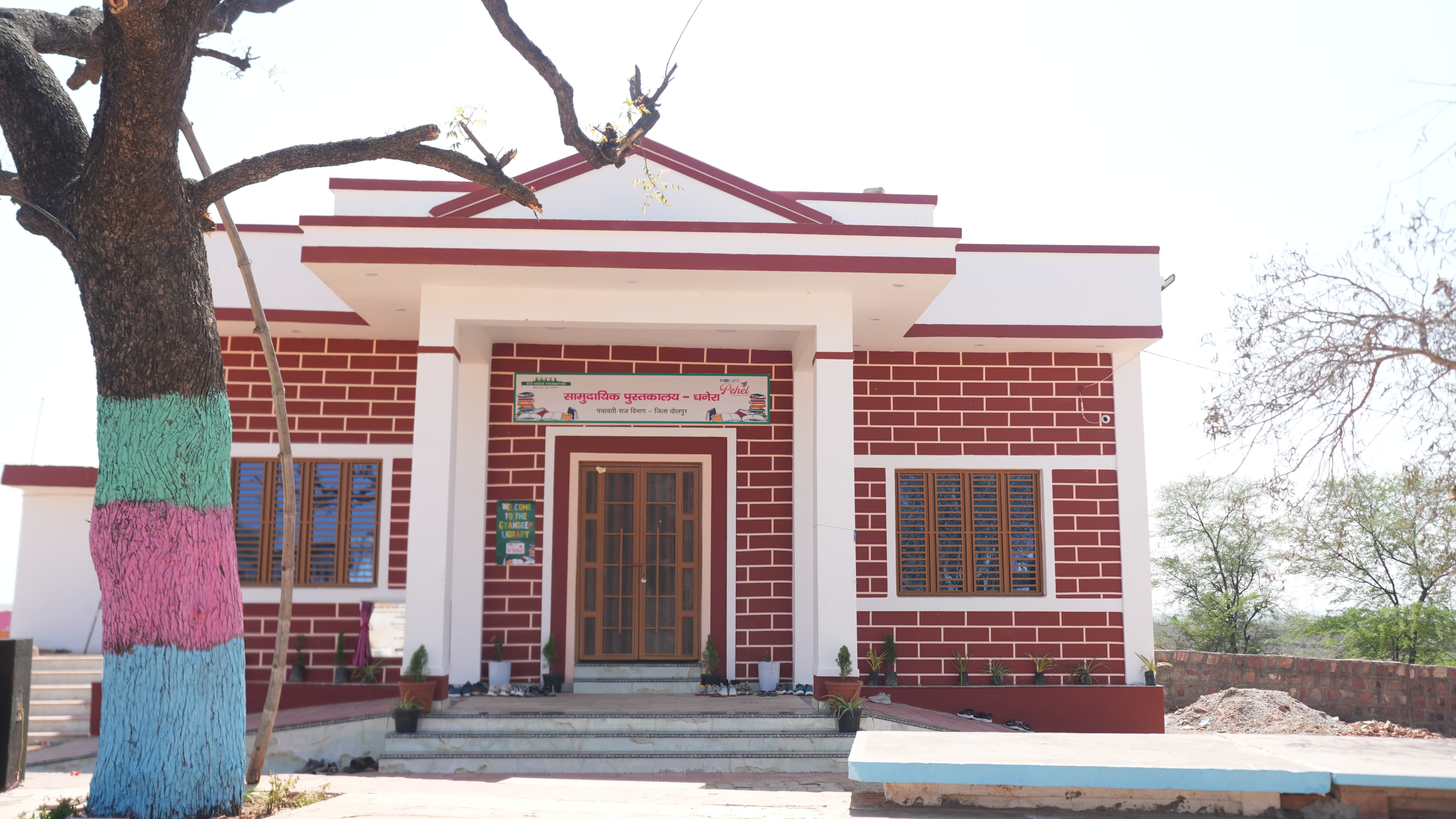
One of the most visible aspects of the project is the transformation of existing community spaces.
Buildings that were previously underutilised have been renovated and repurposed into vibrant learning environments.
- Before: Underutilised community infrastructure.
- After: Books. Computers. Internet. Digital learning. Students. Aspirations.
This approach demonstrates that rural transformation does not always require creating infrastructure from zero. Sometimes the greatest opportunity lies in reimagining what already exists.
Real Impact, Real Aspirations
Behind every library are individual stories: a student preparing for a competitive examination; a girl finding a safe place to study; a young person using a computer for learning; a child discovering books; a job aspirant accessing online resources; and a community coming together around education.
These stories represent the real purpose of ChandraJyoti Abhiyan.
The success of the project will ultimately be measured not merely by how many libraries were created, but by how many lives gained new opportunities because those libraries existed.
Global Learning & Knowledge Exchange
The Dholpur Library Project is also becoming a platform for learning and exchange beyond the district.
Visitors, educational institutions, development practitioners and researchers can study how collaboration between government, CSR, civil society and communities can create scalable rural knowledge infrastructure.
The model provides an opportunity to examine important questions:
- How can rural libraries remain sustainable?
- How can communities take ownership?
- How can technology improve access without replacing the importance of physical community spaces?
- How can libraries become platforms for skills, employment, citizenship, health and lifelong learning?
- Can a village library become an engine for rural transformation?
Dholpur is working to demonstrate what that possibility can look like.
Towards Viksit Bharat
Viksit Library – Viksit Bharat
India’s journey towards Viksit Bharat will depend significantly on the opportunities available to people living outside its major urban centres.
Rural young people need access not only to schools but also to knowledge, technology, skills, guidance and spaces where aspirations can grow.
The Dholpur District Library Project seeks to contribute to this journey by creating such spaces at the grassroots.
When a village gains access to knowledge, its children gain choices. When young people gain skills, communities gain capacity. When citizens understand their Constitution, democracy becomes stronger. When communities take ownership of public institutions, development becomes sustainable.
A developed India requires empowered villages.
Empowered villages require informed communities.
And informed communities begin with access to knowledge.
ChandraJyoti Abhiyan
Lighting the Path from Knowledge to Opportunity.

